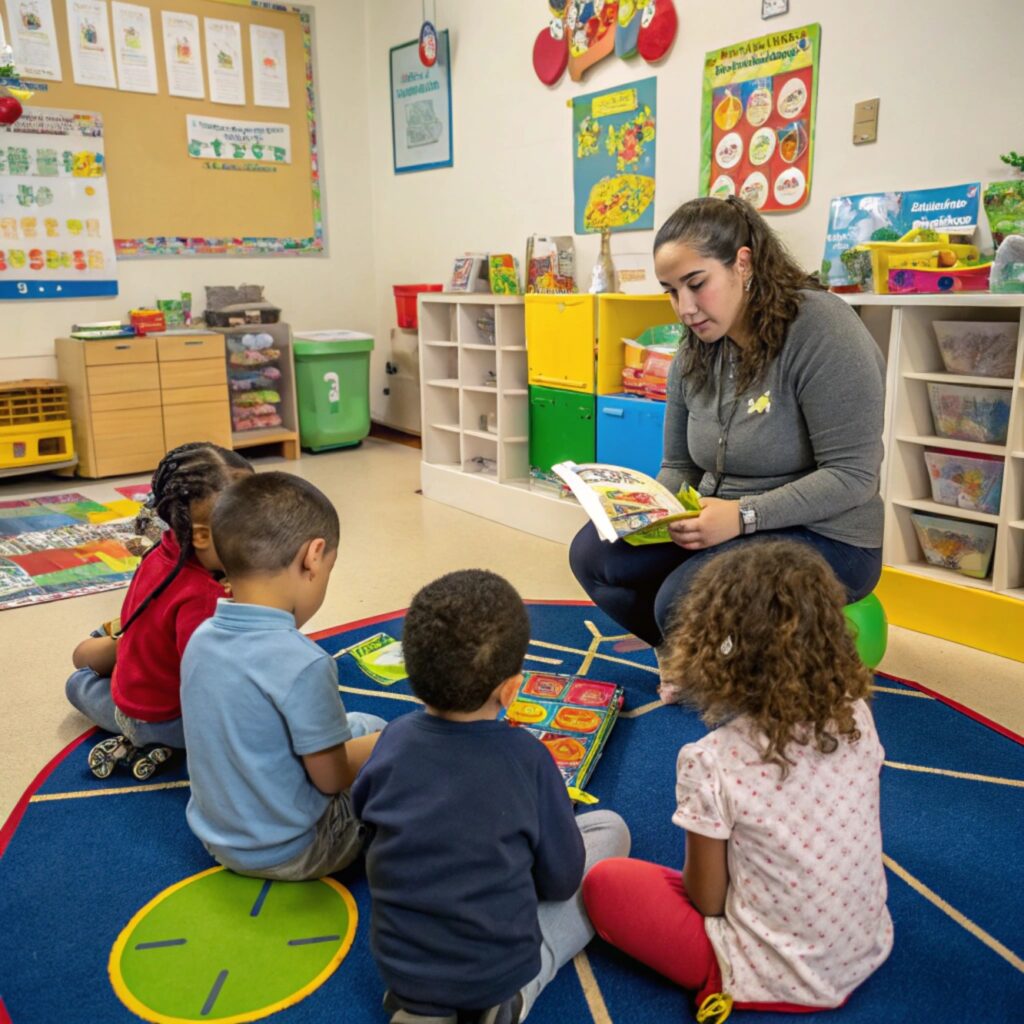


Choosing a preschool means trusting someone else with the little moments that make up your child’s day: asking for help in the bathroom, struggling to share a favorite toy, getting upset when it’s time to clean up, or quietly needing a little reassurance before joining a group. That’s why the preschool teacher to child ratio deserves more attention than it often gets during a school tour.
A preschool with one teacher for eight children offers a different level of availability than a classroom with one teacher for twelve. The difference isn’t that one setting has no group activities or challenging moments. It’s that fewer children are relying on the same adult at any given time.
At Super Bees Academy in Costa Mesa, the teacher-to-child ratio is 1:8, compared with the standard 1:12 ratio used here as a comparison for preschool-age care. For families with children ages two to five, understanding what those numbers mean in everyday situations can help make a preschool decision more informed and less overwhelming.
What Does a Preschool Teacher-to-Child Ratio Actually Mean?
A teacher-to-child ratio tells you how many children are assigned to each teacher. A 1:12 ratio means one teacher is responsible for twelve children. A 1:8 ratio means one teacher is responsible for eight.
The difference becomes clearer when you look at the numbers from the teacher’s perspective. With twelve children, the teacher must divide attention among twelve individual needs. With eight, there are four fewer children competing for that attention.
Imagine a classroom where one child needs help opening a lunch container, another is upset about a toy, and a third needs the bathroom. Meanwhile, the rest of the group is ready to move on to the next activity. These needs don’t arrive one at a time in a neat order. They overlap.
A smaller group can make it easier for a teacher to respond without leaving as many children waiting. It can also give the teacher more opportunities to notice what is happening before a small frustration becomes a bigger disruption.
One important distinction: the ratio is not the same as the total class size. A classroom may have multiple teachers, and the number of children present can change throughout the day. Ask how many children and supervising adults are actually present during the hours your child attends.
Why 1:8 Feels Different From 1:12 in Everyday Preschool Life
The practical value of a small class size preschool is not simply having fewer children in a room. It’s how that difference affects ordinary routines, especially for younger children who are still learning to communicate their needs, manage frustration, and participate in a group.
1. Bathroom help and everyday independence
For a two- or three-year-old, a bathroom trip can involve several steps: recognizing the need, telling an adult, managing clothing, washing hands, and returning to the activity. Some children need reminders or hands-on help. Others are learning to do more independently but still need someone nearby.
When one teacher is responsible for fewer children, it may be easier to provide timely assistance while keeping the rest of the group supervised. A child who needs extra help can receive it without the teacher having to divide attention among as many competing demands.
That doesn’t mean every request will be handled immediately. Teachers still have to manage the classroom as a whole, and the actual experience depends on staffing, routines, and how the school arranges supervision.
2. Meltdowns and big feelings
Young children don’t always have the words to explain why they’re frustrated. A block tower falls, a friend takes a toy, or a parent leaves at drop-off. The result may be tears, shouting, or a child who simply refuses to join the next activity.
In that moment, a teacher needs to acknowledge the child’s feelings, help them settle, and maintain a safe, supportive environment for everyone else.
At a 1:8 ratio, there may be more room for a teacher to pause, get down to the child’s level, listen, and offer reassurance. In a larger group, the same teacher may need to balance that interaction with more children who also need attention.
A smaller ratio doesn’t prevent meltdowns or guarantee that every difficult moment will be resolved quickly. It can, however, create more opportunities for responsive care when emotions run high.
3. Transitions between activities
Preschool days are full of transitions: moving from free play to circle time, washing hands before meals, getting ready to go outdoors, and settling down for rest. These changes can be surprisingly difficult for children who are deeply engaged in what they’re doing.
One child may put toys away as soon as the teacher asks. Another may need a reminder. A third may become upset because they weren’t finished building their structure.
With fewer children per teacher, there can be more opportunities to give individual reminders, explain what’s coming next, and help a child move on without turning the transition into a struggle. The group still moves together, but children may receive more personal guidance along the way.
4. One-on-one moments that build connection
Not every meaningful teacher-child interaction involves solving a problem. Sometimes it’s a brief conversation about a drawing, encouragement when a child tries something new, or a question that helps them think through a simple challenge.
These moments matter because children have different interests, temperaments, and ways of participating. One child may confidently ask questions in front of everyone. Another may need a quieter invitation before sharing an idea.
A 1:8 ratio can create more opportunities for a teacher to notice those differences and respond to each child’s unique needs. It doesn’t turn preschool into private tutoring, but it can make individualized attention easier to incorporate into a group setting.
What About STEM Activities and Hands-On Learning?
In a Montessori-inspired, STEM-focused environment, children learn through exploring materials, asking questions, testing ideas, and discovering how things work. A simple building activity, for example, might involve comparing shapes, balancing blocks, or figuring out why a structure keeps falling over.
Children won’t all approach the activity in the same way. One may immediately begin building. Another may watch for a while before joining in. A third may need help using the materials safely or finding a starting point.
With eight children per teacher rather than twelve, the teacher may have more opportunities to observe these different approaches, ask follow-up questions, and offer support without taking over the activity.
The goal isn’t for an adult to direct every move. Children also need room to experiment, make mistakes, play independently, and learn alongside their peers. A useful balance gives children freedom to explore while keeping an attentive adult available when guidance is needed.
Families considering Super Bees Academy can explore the school’s early learning programs to understand how its learning environment fits their child’s age and needs.
Is a 1:8 Ratio the Same as a 1:4 Ratio?
No, and the distinction matters. A 1:4 ratio means one teacher is responsible for four children, while a 1:8 ratio means one teacher is responsible for eight. A 1:12 ratio means that teacher is responsible for twelve.
Comparing 1:4 with 1:12 can help illustrate why adult availability matters, but families should compare like with like. Age groups, classroom arrangements, staffing requirements, and the way a center counts teachers can all affect what a ratio means in practice.
For a preschool-age child, 1:8 is still a group-care setting. The teacher will lead activities, supervise several children at once, and help the group follow its daily routine. There won’t be an adult focused exclusively on your child throughout the day.
What changes is the number of children sharing that teacher’s attention. Compared with 1:12, a 1:8 ratio means four fewer children per teacher. That can make a meaningful difference in how much flexibility a teacher has to respond to individual needs, even though it doesn’t guarantee a particular outcome for every child.
Preschool Ratio in California: What Parents Should Verify
When researching preschool ratio California requirements, it’s important to distinguish a school’s stated ratio from the applicable licensing rules. Requirements can depend on children’s ages, the type of program, staff qualifications, and other regulatory details.
Don’t assume that a ratio described as standard applies to every preschool in every circumstance. A 1:12 figure is a useful comparison for understanding staffing differences, but it should not be treated as a universal statement of California law or a guarantee that every program operates under the same rules.
Ask the center which licensing category applies to its program, what staffing requirements govern your child’s age group, and how the center maintains its stated ratio throughout the day. If a center advertises a 1:8 ratio, ask whether that number reflects the actual children and qualified supervising staff present in your child’s classroom, rather than the school’s overall enrollment or staffing plan.
The answer should be clear enough for you to understand how your child will be supervised during ordinary routines and unexpected situations.
How to Look Beyond the Numbers When Choosing a Preschool
Ratios matter, but they’re one part of the decision. A classroom can have a favorable ratio and still feel like a poor fit for a particular child. Pay attention to how adults speak to children, how the environment is organized, and whether the daily routine feels welcoming and manageable.
During a visit to Super Bees Academy, look at the classroom as children actually experience it. Is there space to play and explore? Do teachers acknowledge children who need help? Can children move between activities with appropriate guidance? Do adults seem attentive to the whole group without overlooking individual children?
Practical details matter to families, too. Super Bees Academy offers home-style hot meals, a large open playground, secured access control, separate secured parking, and convenient highway and freeway access. Its hours are 7 AM to 6 PM, with no early drop-off and no late pick-up, so parents should make sure those hours fit their daily schedule.
The center also has a simple, more affordable rate structure. Ask the school directly for current pricing and any details you need to understand before enrolling; don’t rely on assumptions about what a rate includes.
You can also read more about the school’s approach and environment on its about page. The best choice is one where the staffing approach, daily routine, practical arrangements, and atmosphere work for your family.
Three Questions to Ask About Ratio During the Day
A ratio shared during a tour is a useful starting point. The next step is understanding whether it holds during the parts of the day when supervision can become more complicated.
- During nap or rest time: How many children are present per supervising teacher, and who remains responsible for children who are awake or need help?
- During outdoor play: How do you maintain the stated ratio while supervising the playground, helping individual children, and managing transitions in and out?
- During pick-up: How is the ratio maintained as families arrive, children leave at different times, and teachers communicate with parents?
Listen for specific explanations rather than general reassurance. A center should be able to describe how it organizes supervision during these routines and what happens when a staff member needs to step away or a child requires additional support.
These questions are useful whether you’re comparing a 1:8 ratio with a 1:12 ratio or evaluating two schools that advertise the same number. What matters is understanding how the stated ratio translates into real supervision throughout your child’s day.
A Smaller Ratio Is About the Everyday Moments
The difference between 1:8 and 1:12 isn’t that one preschool has challenges and the other doesn’t. Children will still need help, experience big feelings, learn to share, and adjust to transitions. Teachers will still balance individual needs with the needs of the group.
A smaller class size can give teachers more opportunities to respond thoughtfully, notice individual differences, and offer support when children need it. For parents of children ages two to five, that practical difference is worth exploring alongside the school’s learning approach, environment, safety arrangements, and daily schedule.
If you’re considering Super Bees Academy, come see the environment and ask how its 1:8 teacher-to-child ratio works throughout a typical day. There’s no need to decide based on a number alone.
Schedule a tour to learn more about the program and decide whether it’s the right fit for your family.