
Your curious three-year-old isn’t just playing when she stacks blocks or asks “why?” for the hundredth time today—she’s doing science. Here’s why nurturing that natural curiosity through STEM learning gives preschoolers a powerful head start.
If you’ve ever watched a toddler spend 20 minutes figuring out how to fit shapes into a sorter, you’ve witnessed something remarkable: a tiny scientist at work.
That intense concentration? That’s problem-solving. The trial and error? That’s the scientific method in action. The pure joy when they finally get it right? That’s the foundation of a lifelong love of learning.
This is exactly why STEM education—Science, Technology, Engineering, and Mathematics—isn’t just for older kids anymore. When introduced at the preschool level, STEM learning transforms everyday curiosity into structured thinking skills that benefit children for years to come.
But what does STEM actually look like for a 3- or 4-year-old? And why are early childhood experts so enthusiastic about it?
Let’s dig in.

What Is STEM Learning for Preschoolers?
First, let’s clear up a common misconception: STEM for preschoolers doesn’t mean sitting kids in front of computers or teaching them algebra. Not even close.
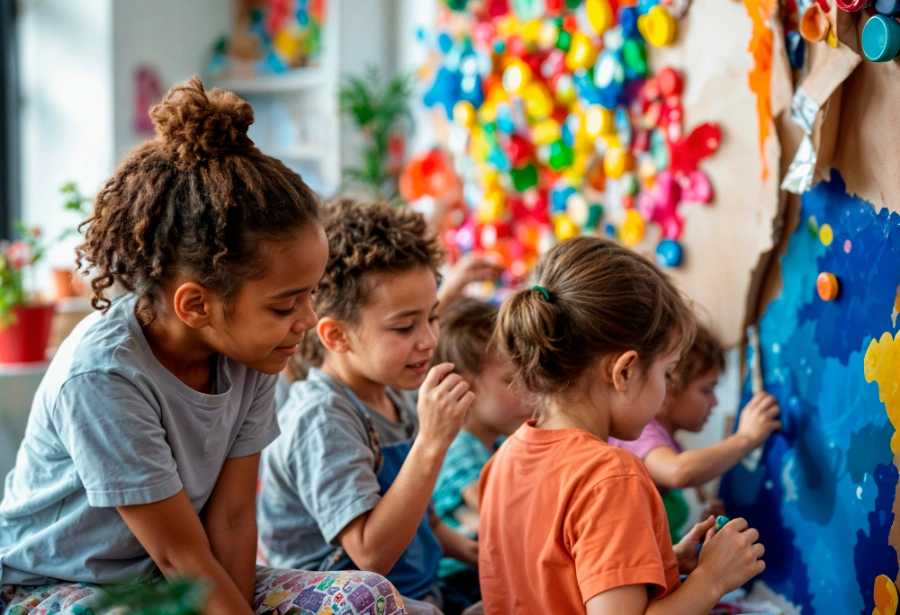
At the preschool level, STEM is hands-on, play-based, and built around what children naturally love to do—explore, build, question, and discover.
It looks like:
- Science: Watching caterpillars transform into butterflies. Mixing colors. Planting seeds and tracking their growth.
- Technology: Using simple tools like magnifying glasses, balance scales, or age-appropriate tablets for learning games.
- Engineering: Building towers with blocks. Constructing bridges with popsicle sticks. Figuring out why the marble run keeps getting stuck.
- Mathematics: Sorting objects by size and color. Recognizing patterns. Counting steps to the playground.
The magic of preschool STEM is that children rarely realize they’re “learning.” To them, it’s just play—which is exactly how it should be.
7 Powerful Benefits of STEM Learning for Preschoolers
1. Builds Critical Thinking Skills Early
Here’s something that surprises many parents: the brain develops more rapidly between ages 0 and 5 than at any other time in life. During these years, children form over one million new neural connections every second.
STEM activities take advantage of this incredible brain plasticity by encouraging children to think critically rather than just memorize.
When a preschooler tries to figure out why her block tower keeps falling, she’s not just playing—she’s hypothesizing, testing, analyzing results, and adjusting her approach. These are the same thinking patterns that will help her solve complex problems in school and beyond.
2. Encourages Natural Curiosity
Every parent knows the “why” phase. Why is the sky blue? Why do dogs bark? Why can’t I eat ice cream for breakfast?
While these endless questions can be exhausting, they represent something beautiful: an innate drive to understand the world.
STEM learning channels this curiosity productively. Instead of shutting down questions, a STEM-focused environment celebrates them. Children learn that asking “why” and “how” leads to fascinating discoveries—a mindset that fuels lifelong learning.
3. Develops Problem-Solving Abilities
Life is full of problems to solve, and the earlier children develop problem-solving skills, the better equipped they’ll be to handle challenges.
STEM activities present age-appropriate problems that children can work through:
- How do I make this ramp steep enough for my car to go fast?
- What happens if I add more water to the sand?
- Why won’t these two puzzle pieces fit together?
Through guided exploration, preschoolers learn that problems aren’t scary—they’re puzzles waiting to be solved. They develop persistence, resilience, and the confidence to try different approaches when the first one doesn’t work.
4. Strengthens Language and Communication Skills
This benefit often surprises parents, but STEM learning significantly boosts language development.
How? STEM activities give children rich experiences to talk about. When a child observes a science experiment, she needs words to describe what she sees. When she builds something, she wants to explain how she did it.
Teachers in STEM-focused preschools intentionally introduce vocabulary like “predict,” “observe,” “compare,” “measure,” and “discover.” These words become part of children’s everyday language, expanding their ability to express complex ideas.
5. Promotes Collaboration and Social Skills
STEM projects naturally lend themselves to teamwork. Building a big structure? You’ll need help. Conducting an experiment? It’s more fun with friends.
Through collaborative STEM activities, preschoolers learn essential social skills:
- Taking turns
- Sharing materials
- Listening to others’ ideas
- Compromising when there’s disagreement
- Celebrating group successes
These social-emotional skills are just as important as academic readiness when it comes to kindergarten preparation—and life success.
6. Builds Confidence and a Growth Mindset
One of the most valuable gifts we can give children is the belief that they can figure things out.
STEM learning builds this confidence naturally. When children successfully complete a challenge—whether it’s building a bridge that holds weight or mixing colors to create a new one—they experience genuine accomplishment.
Even more importantly, STEM teaches children that failure is part of learning. The tower fell down? Great! Now we know one way that doesn’t work. Let’s try something different.
This “growth mindset” approach helps children see challenges as opportunities rather than threats—a perspective that serves them well throughout their education and careers.
7. Prepares Children for the Future Job Market
Here’s a statistic worth considering: according to the U.S. Bureau of Labor Statistics, STEM occupations are projected to grow significantly faster than non-STEM occupations over the coming decade.
While we can’t predict exactly what jobs will exist when today’s preschoolers enter the workforce, we do know that skills like critical thinking, problem-solving, creativity, and technological literacy will be essential.
Early STEM exposure doesn’t guarantee your child will become an engineer or scientist. But it does build the foundational thinking skills that open doors to a wide range of future opportunities.
What Does Quality STEM Learning Look Like in Preschool?
Not all STEM programs are created equal. Here’s what to look for in a preschool that takes STEM seriously:
Hands-On, Play-Based Approach Young children learn by doing, not by sitting and listening. Quality STEM programs prioritize hands-on exploration over worksheets or screen time.
Integrated Throughout the Day: STEM shouldn’t be a 15-minute “special” activity. The best programs weave STEM thinking into circle time, outdoor play, art projects, and even snack time (cutting a banana into equal pieces is math!).
Low Student-to-Teacher Ratios: STEM learning requires individualized attention. When teachers can observe each child’s thinking process and ask probing questions, learning deepens significantly.
Trained, Enthusiastic Teachers: Teachers don’t need engineering degrees, but they do need training in how to facilitate STEM exploration and the enthusiasm to nurture children’s natural curiosity.
Safe Environment for Experimentation Children need to feel safe to try, fail, and try again. This requires both physical safety and emotional safety—an environment where mistakes are celebrated as learning opportunities.
Simple STEM Activities You Can Do at Home
Want to extend STEM learning beyond the classroom? Here are some easy activities for home:
Kitchen Science
- Mix baking soda and vinegar to watch the fizzy reaction
- Freeze water in different containers and compare melting times
- Sort groceries by color, size, or food group
Outdoor Engineering
- Build dams in puddles or streams
- Construct fairy houses from natural materials
- Create obstacle courses and time how fast family members complete them
Everyday Math
- Count stairs as you climb them
- Compare sizes: “Is this apple bigger or smaller than that orange?”
- Set the table and count out the correct number of plates, forks, and cups
Simple Technology
- Use a magnifying glass to examine leaves, bugs, or fingerprints
- Take photos of nature finds and create a digital scrapbook
- Use kitchen timers for games and activities
The key is following your child’s interests. If she loves bugs, explore entomology together. If he’s obsessed with cars, experiment with ramps and speed. When learning connects to genuine curiosity, it sticks.
Addressing Common Parent Concerns About Early STEM
“Isn’t my child too young for STEM?” Absolutely not. Children are natural scientists from birth. STEM learning simply provides vocabulary and structure for exploration they’re already doing.
“I’m not good at math or science. How can I support this?” You don’t need to be an expert—just be curious alongside your child. When you say, “I don’t know; let’s find out together,” you model the most important STEM skill of all: the willingness to explore the unknown.
“Will this replace creative play?” Quality STEM education enhances creativity, not replaces it. Designing a structure, solving a problem, and imagining possibilities are deeply creative acts.
“Is this just a trend?” While “STEM” as a buzzword is relatively new, the underlying principles—curiosity, exploration, and critical thinking—have always been foundational to quality early childhood education. STEM simply provides a framework for intentional focus on these skills.
Setting Your Child Up for Success
The preschool years are a window of extraordinary opportunity. During this time, children’s brains are uniquely primed to develop the thinking patterns that will serve them for life.
STEM learning isn’t about creating tiny geniuses or pushing academic content earlier and earlier. It’s about honoring children’s natural curiosity, providing rich opportunities for exploration, and building the confidence to tackle challenges.
When you choose a preschool that values STEM learning, you’re not just preparing your child for kindergarten—you’re laying the foundation for a lifetime of creative problem-solving and joyful discovery.
Discover STEM Learning at Super Bees Academy
At Super Bees Academy in Costa Mesa, we believe every child is a natural-born scientist, engineer, and mathematician. Our STEM-based curriculum transforms everyday moments into learning opportunities—from our sensory exploration tables to our outdoor discovery garden.
What makes our approach special?
✅ Small class sizes (1 teacher for every 8 children) for individualized attention
✅ Experienced teachers trained in early childhood STEM facilitation
✅ Hands-on, play-based learning integrated throughout the day
✅ Safe, nurturing environment where curiosity is celebrated
We’ve been part of the Costa Mesa community for over 25 years, helping children ages 6 weeks to 6 years develop the skills and confidence they need to thrive.
Ready to see STEM learning in action?
📞 Call us at 714-540-1775 to schedule a tour 📍 Visit us at 758 Saint Clair Street, Costa Mesa, CA
Currently offering enrollment specials—ask about 2 weeks of free tuition for new families!
Looking for a preschool in Costa Mesa that nurtures your child’s natural curiosity? Super Bees Academy combines a STEM-based curriculum with the warmth of a family environment. Contact us today to learn more.